Makerfaire is pretty famous in the US and there have only been a few of them in Europe. The dates for the next one are finally confirmed on the Makerfaire UK site.
I have tried out the Scope Clock on a couple of different oscilloscopes.
Tektronix 604 Monitor.
The Tek 604 Monitor is a X-Y monitor with intensity control on the Z input. It has a flat and sharp screen. Funny thing about the 604 is that it has no fan and no power indicator and you will not display much if you don’t get the signals right. So when i first powered it up i thought it was broken. Like many Tek machines of this era it is well built and engineered.
Scope Clock on Tek 604
Tektronix 465 Oscilloscope
The Tektronix 465 is a single beam, dual channel 100 MHz Oscilloscope. Mine wat built around 1973. Everything on the 465 makes it clear this machine is from a different time. The controls are sturdy, the illumination are little light bulbs and not LEDs. The scope is not just electronically complicated but also has many mechanical parts just to put the actual switches in the best spot in the signal path and put the control of the switch on a logical place on the front panel. The schematics are hand drawn. The X-Y mode is a position on the timebase.
Scope Clock on a Tek 465, scale illumination and intensity turned up.Scope Clock on a Tek 465Magnification of Scope Clock on a Tek 465
Fluke PM3092.
The Fluke PM3092 is a dual beam, 4 channel, 200 MHz analog scope with digital control. It has the disadvantages of an analog scope combined with the confusing controls of a modern scope. The Fluke and I are not good friends. The X-Y mode is hidden in “TB-mode”, soft-menu “X-DEFL” off, channel 1 off.
Scope Clock on Fluke PM3092Magnification of part of the Scope Clock image on a Fluke PM3092
HP 546xx series Oscilloscopes.
The HP 54602B and 54622D are digitising oscilloscopes, basically a computer with fast AD converters. The display is a monochrome CRT. The controls are well designed and present an interface that is easy to understand for both traditional analog scope users and users more used to digital systems. These were built around 1996. The X-Y mode can be set by pressing “Main / Delayed” and then the softmenu “X-Y”.
AVR Scope Clock on a HP 54602BScope Clock on HP 54622DMagnification of part of the Scope Clock image on a HP 54622D
The BCR2000 is a midi controller from Behringer . You can use it to modify midi parameters with pushbuttons and rotary knobs.
The BCR2000 is not really expensive (current price (Sept 2010) is 139,- euro from feedback). It has a few minor drawbacks like the infamous “wobbly knobs”.
All rotary encoders have a string of leds as indicators. I had expected Behringer would have used prefab modules with switch and LEDs for this from Bourns or Avago and was surprised to see this was not the case. All rotary knob and led parts are built up from separate parts. The BCR2000 consists of an amazing number of parts.
The BCR2000 has a swichmode power supply an d 3 other PCB-s.
Power supply
Lower Board
6 x HC574 “Octal Edge-Triggered D-Type Flip-Flops With 3-State Outputs”
4 x HC273 “Octal D-Type Flip-Flops With Clear”
6 x HC163 “4-Bit Synchronous Binary Counters”
1 x HC138 “3-Line To 8-Line Decoders/Demultiplexers”
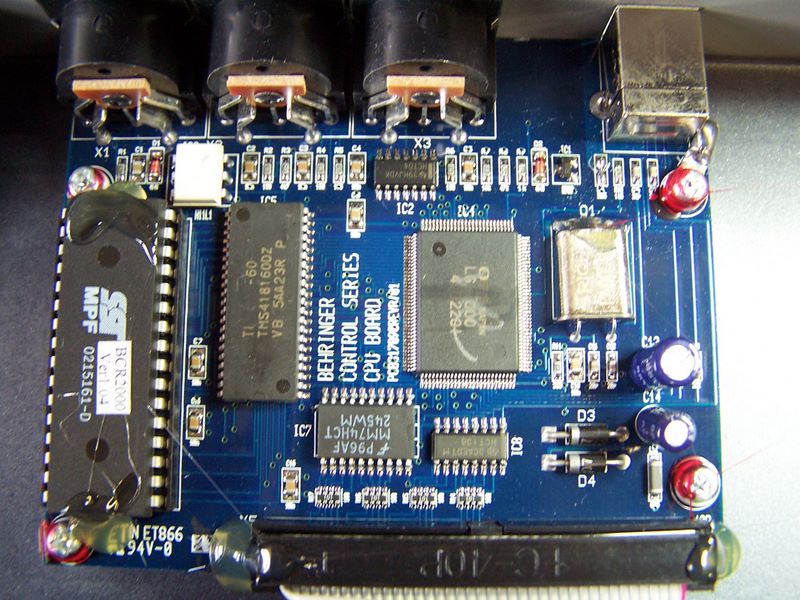
1 x PDF OKI L671000: An ARM7TDMI CPU with full speed USB and UART, handy for MIDI.
1 x TMS 418160DZ, a 2 MB DRAM. The CPU apparently has DRAM Refresh logic on board.
1 x HCT04 “Hex Inverters”
1 x H11L1 “6-Pin DIP Schmitt Trigger Output Optocoupler” for the receiving side of the MIDI current loop.
1 x HCT245 “Octal Bus Transceivers With 3-State Outputs”